User guide
Build a playlist
Find your Yoto playlists
Connect your account in Compte, then open Playlists. Your Make Your Own creations load automatically from Yoto at startup and after login. Click a title to open its current content.
The list represents your Yoto playlists. A cache keeps the latest loaded data available; audio files you prepare stay in the local library. Actualiser depuis Yoto reloads changes made elsewhere.
Add audio
- Open your playlist and choose
Ajouter des médias. - In the dialog, check the audio files you want from your library.
- Choose each file's version if you have prepared more than one.
- Choose
Ajouter (1)(the number counts your selection) to send it to Yoto. - Wait for confirmation. The dialog stays open while the audio is sent, then closes, and the tracks appear in the playlist.
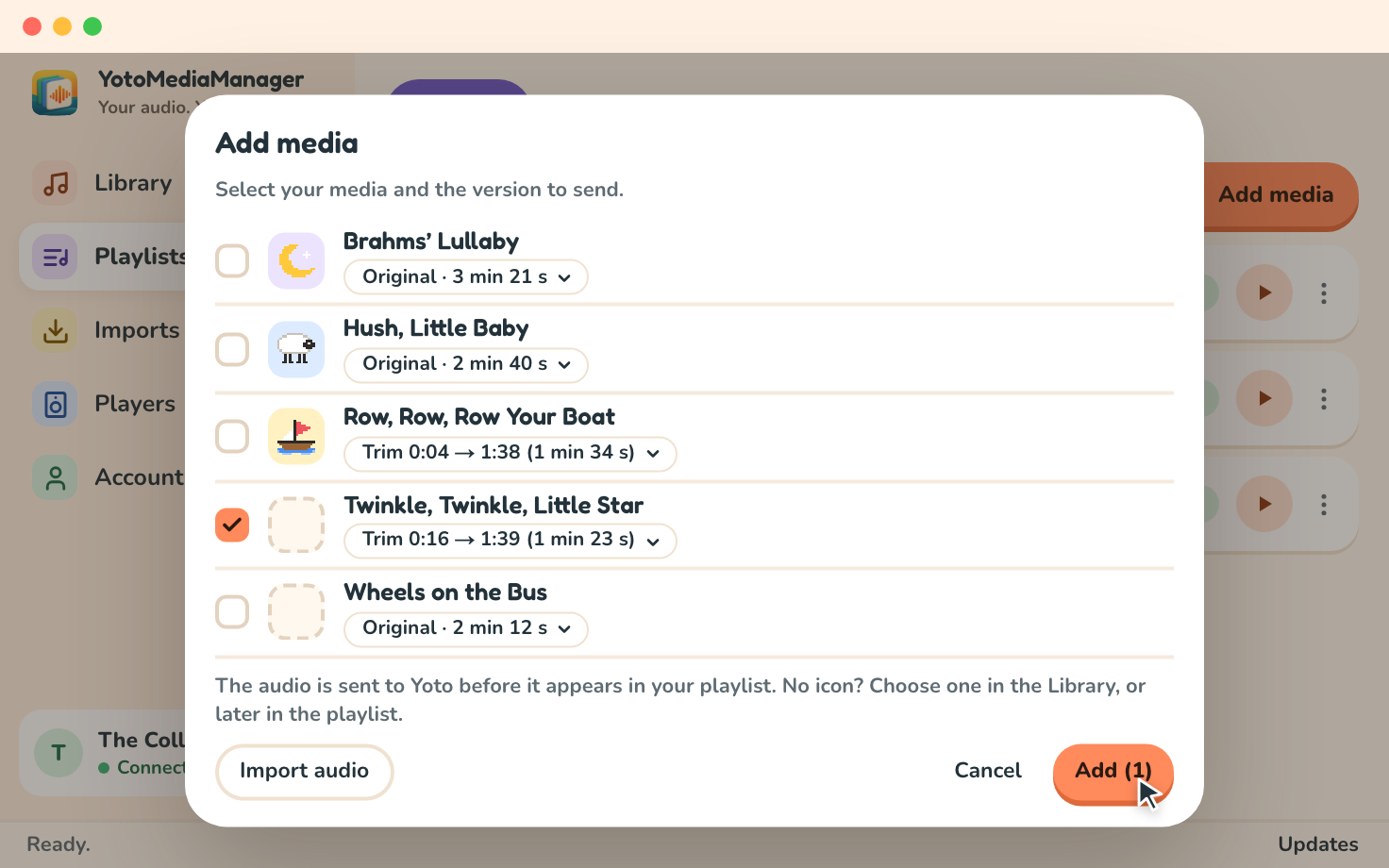
A media without an icon arrives with an empty icon slot; you can choose its icon right after (see below). Importer de l’audio opens the Imports screen so you can add a file or YouTube link to your library. Prepare that audio, then return to the playlist and select it. Importing into the library does not automatically add media to a playlist.
Versions already uploaded to the active account are reused. A new trim may require another upload. The original remains on your computer.
Yoto accepts tracks of up to one hour. Audio longer than 55 minutes, such as an audiobook, is cut automatically when you add it: it becomes one chapter with several tracks named « <titre> — partie 1/3 », « partie 2/3 »… of equal length. Each part is prepared separately so the cuts are clean, and parts already prepared or uploaded are reused when you add the same audio again. The audio's detail panel in Médiathèque tells you in advance how many parts it will become. Playlists stay limited to 100 tracks and 5 hours in total.
Create and edit
Enter a title and choose Créer une playlist. The playlist is created on Yoto, and the editor opens after confirmation, even if it has no audio yet.
Changes are saved to Yoto automatically; there is no save or publish button. Text is sent a moment after you stop typing, or as soon as you leave the field or press Enter. Several quick changes, such as moving a track up three times or changing a few icons, are grouped and sent together.
The tag next to the title shows Enregistrement… while changes are on their way and Enregistré sur Yoto once Yoto has them. You can keep editing meanwhile: what you change during a save is sent right after it. Changes still waiting are sent when you open another playlist or page and before the app quits. If they cannot be saved, a message names the playlist and explains why; when quitting, you can stay or choose Quitter quand même.
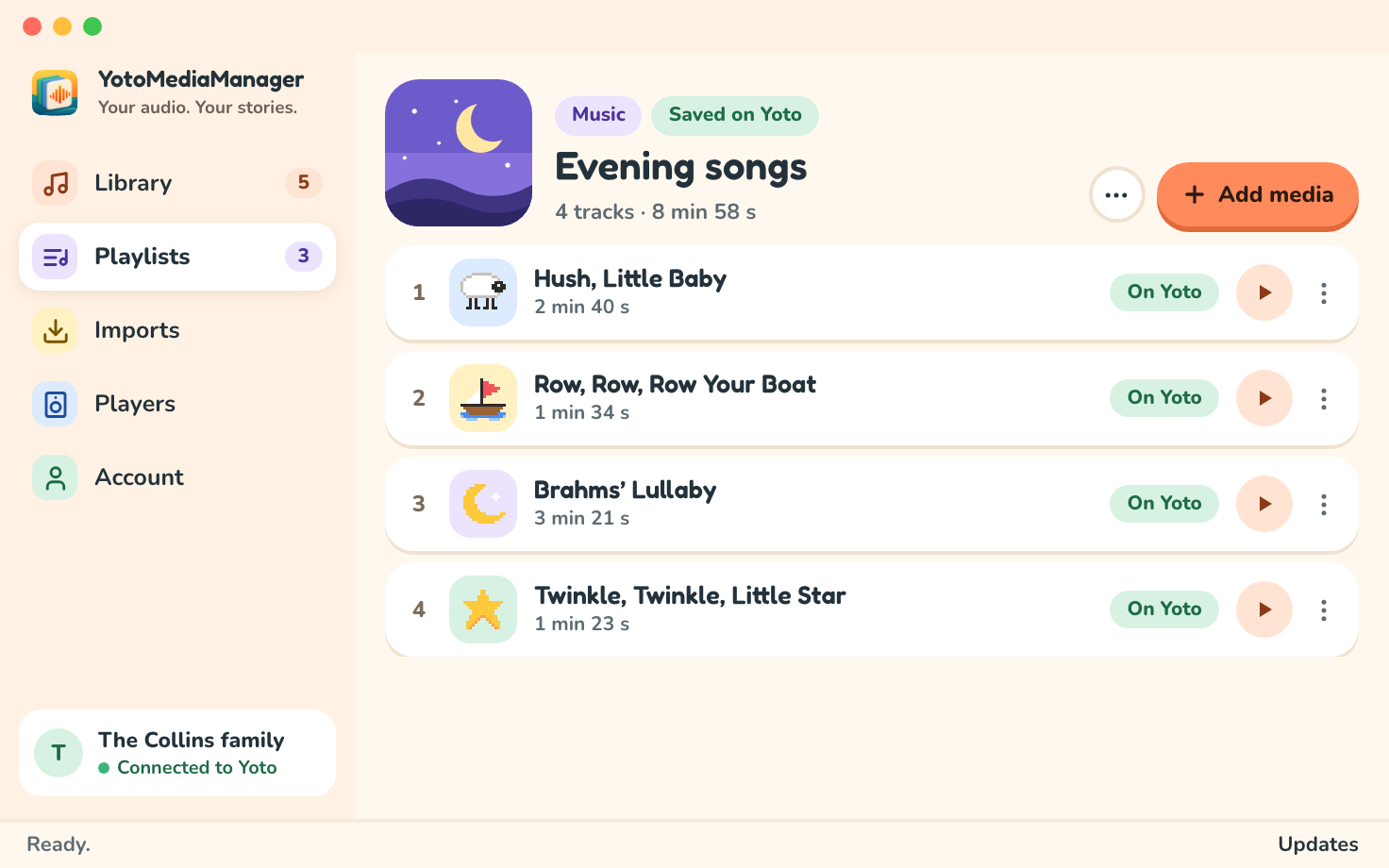
If an error occurs, the message and task details explain what still needs attention.
Choose illustrations
A cover represents the playlist. Small icons represent its chapters or tracks on the player.
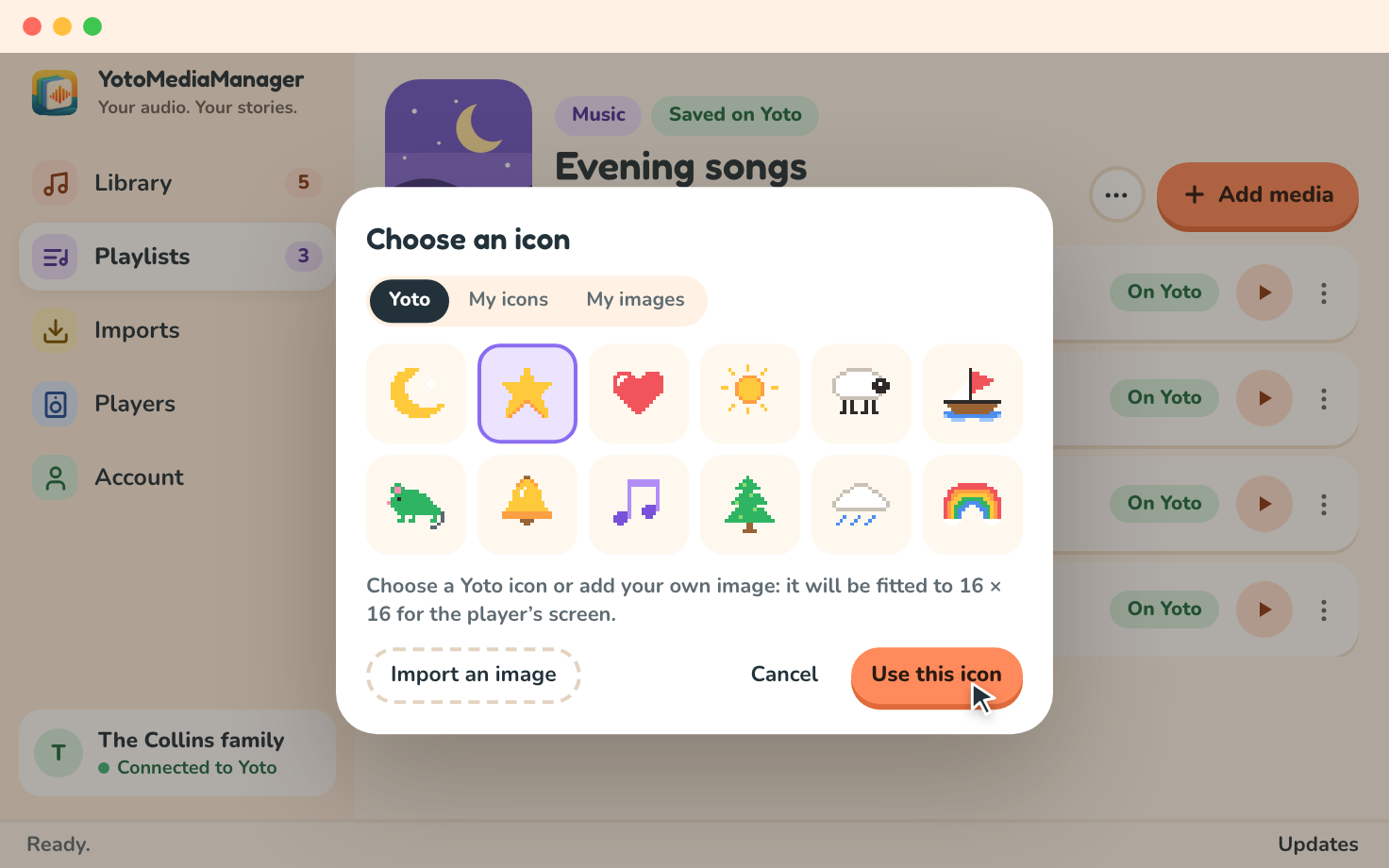
Click a track's icon, or its empty slot marked +, or choose Changer l’icône in the track's ⋮ menu. The Choisir une icône dialog offers the Yoto catalog, Mes icônes (your icons on Yoto) and Mes images (pictures you imported before). Select an icon and choose Utiliser cette icône, or choose Importer une image to use a picture of your own: it is fitted to 16 × 16 for the player's screen. The dialog closes and the change is saved to Yoto with your other changes.
An icon chosen for a media in Médiathèque comes with it into the playlists you add it to afterwards.
A song displays a single title. Playlists with chapters containing multiple tracks keep that structure; their detailed settings remain available in the menus.
Choose playback behavior
Linear playback follows the chapters and tracks in order. End-of-track settings let playback continue to the next track, repeat, or stop.
Interactive playback, events, random playback ranges and streams are under the playlist's Réglages avancés, shown only when Mode avancé is on in Compte. Some order changes are blocked if they would make an event reference ambiguous. Update the affected events before continuing.
Duplicate or delete
In Plus, duplication creates a new playlist on Yoto. Deleting a playlist removes it from your Yoto account and keeps your original audio in the library.
Changes elsewhere or an uncertain upload
Opening or refreshing a playlist reads its content from Yoto again. If another app changed it during your operation, a conflict may require a choice. Your edits are preserved to let you resolve it.
If Yoto may have accepted an upload but its response did not arrive, open the task details in Imports and choose Vérifier auprès de Yoto. The app checks the result before allowing another upload, to avoid duplicates.